A date doesn't need an agent, it needs a calendar
Somebody booked a visit for June 7. Sofía saved it for July 6. The person showed up on June 7, and nobody was there.
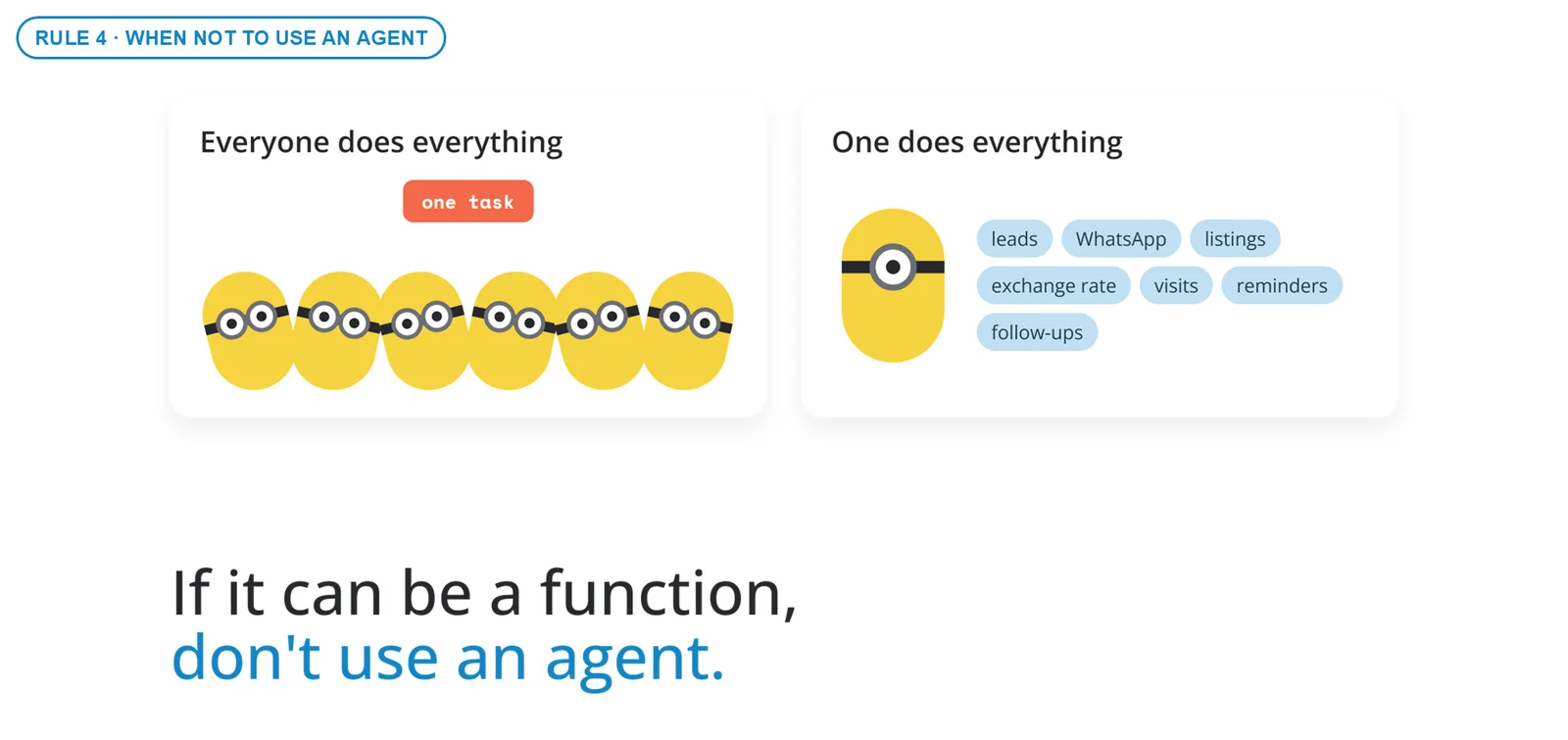
Sofía is a friend's agent. He came to me one day and said "Sofía is being really dumb, help me make her smarter", and when I opened the prompt it was 26,000 lines long. Sofía had to qualify Instagram leads, reply on WhatsApp, search thousands of properties, suggest alternatives, check the day's exchange rate, book visits, send reminders and follow up 24 hours later.
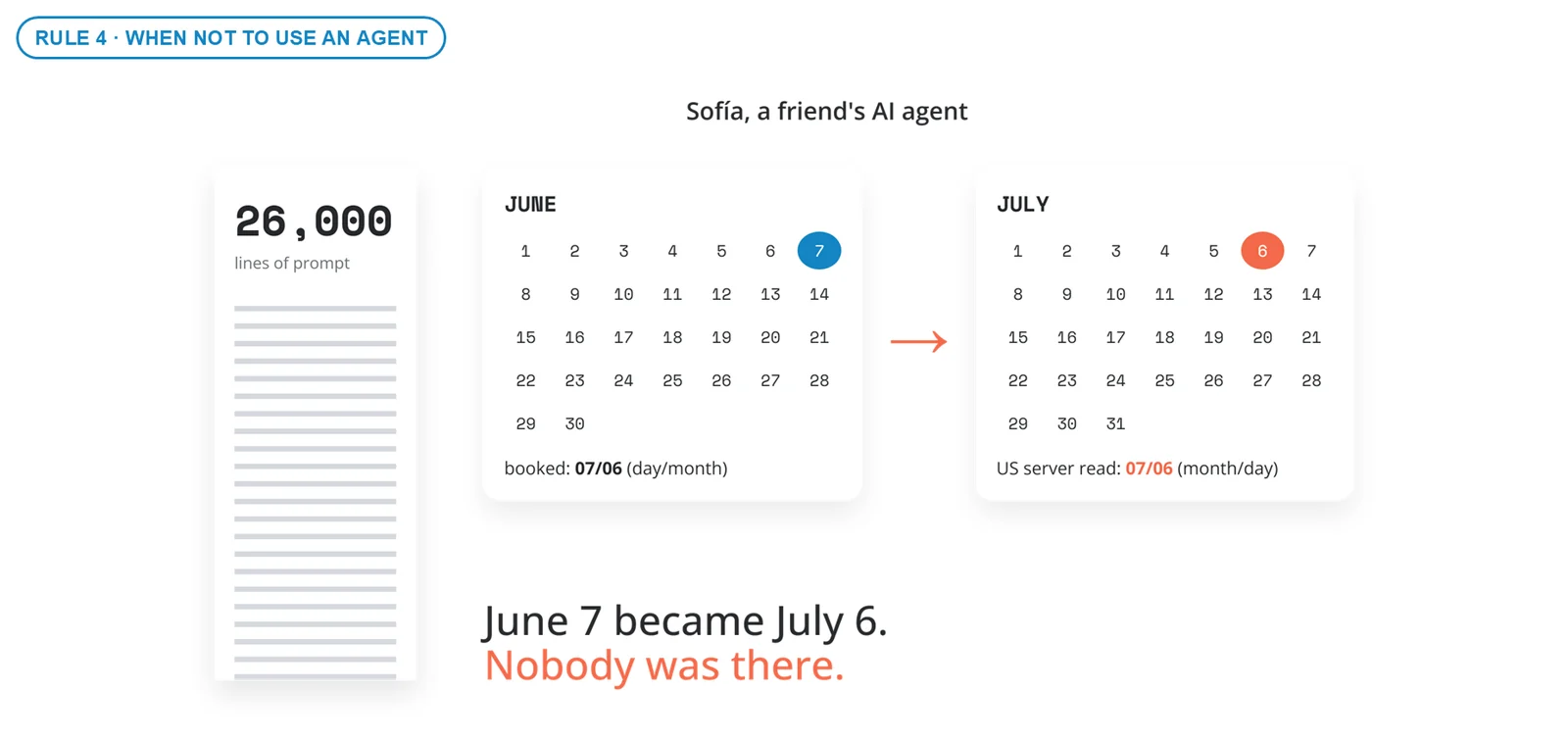
The date thing wasn't a lack of intelligence. The server was in the United States, where dates are written month first, and the AI doesn't know where it is or what time it is. Your message can be processed in Brazil, in Spain or under the ocean, and if you don't tell it where you are, it calculates with somebody else's clock.
She knew so much she knew nothing
My friend thought Sofía was going to be his everything, and that was wanting to drive a Ferrari when what you can afford to run is a Twingo: every new task he hung on the prompt took a little attention away from the rest, until she was doing eight things halfway.
It's the programmer joke. His mom says "bring me a carton of milk, and if they have eggs, bring six", and he comes back with six cartons of milk. They had eggs. The instruction was crystal clear to the person who gave it and perfectly ambiguous to the person who received it, and with 26,000 lines of instructions, imagine how many eggs there are.
With agents I see two ways to fail. One is having everybody do everything, like when the minions all pile onto the same thing. The other is having a single one do it all, like Sofía.
When not to use an AI agent
Converting a date, working out a price with the day's exchange rate, checking whether a time slot is free, sending a reminder 24 hours ahead: none of that takes judgment, and we already knew how to do all of it twenty years ago, with no surprises and almost for free. An agent is useful where something has to be interpreted, like working out what somebody wants when they write "something close to the metro, and not a fourth floor with no elevator".
That's why the cheapest decision is not to use an agent, and my rule fits on one line: if it can be a function, don't use an agent.
Take the agent you have today, or the one you're about to build, and list everything you ask of it. Then cross out whatever always has the same answer for the same input. What's left on the list is the agent's job, and what you crossed out needs a calendar.
This article is part of the series from my AI Week 2026 talk: talk resources and slides. Next: 163 rules for working with AI agents.
Subscribe
Get posts about AI, development, and the solo founder journey.